How to Use Mock Tests the Right Way for UPSC Prelims

How to Use Mock Tests the Right Way for UPSC Prelims
Mock tests become especially important in the final stretch before Prelims. But many aspirants still use them mainly as scorecards.
That is where much of their value gets lost.
A good mock is not just meant to show your score. It is meant to reveal where you stand, what is going wrong, and what to fix next.
Why mock tests matter#
UPSC Prelims tests more than memory. It also tests judgment, elimination, time management, and composure under pressure.
Revision helps with coverage. Mock tests show whether that preparation is actually translating into exam readiness.
What aspirants often get wrong#
Many aspirants take a mock, check the marks, and move on. But the more useful question is not “How much did I score?” It is “Why did I score this way?
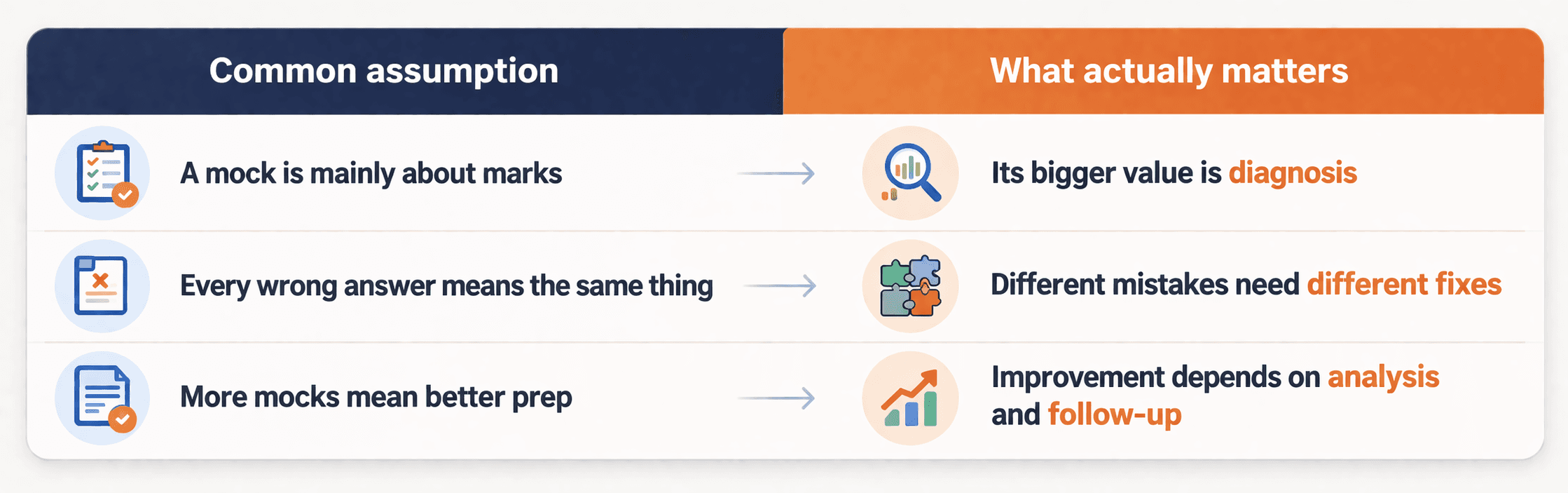
A score can tell you where you stand. It cannot, by itself, tell you what needs attention.
Why weak areas are different for every aspirant#
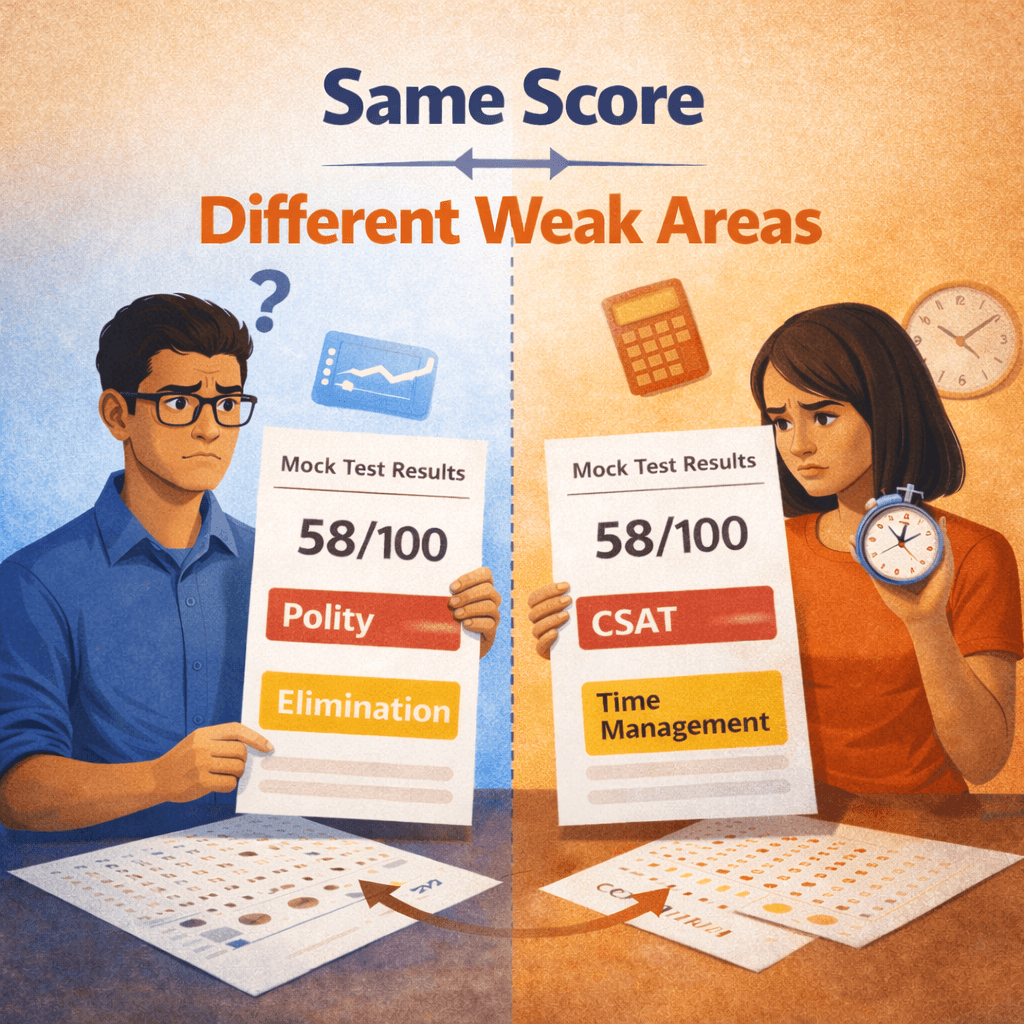
Two aspirants can score the same marks and still need very different next steps.
One may be weak in Polity basics. Another may know the content but lose marks in current-affairs-linked questions. One may be comfortable in GS but shaky in CSAT. Another may struggle more with judgment than knowledge.
That is why generic post-mock revision is often inefficient. A mock becomes far more useful when it helps an aspirant identify their own specific weakness.
How to analyze a mock properly#
A useful mock analysis does not need to be complicated. It just needs to be honest.
After every mock, resist the urge to move on quickly. Sit with the paper for at least 20–30 minutes and ask:
- What did I get wrong? — List every incorrect answer.
- Why did I get it wrong? — Assign each one a category: knowledge gap, concept confusion, poor elimination, or time pressure.
- Which weakness repeated? — If 4 out of 6 Polity errors were elimination mistakes, that is a pattern, not bad luck.
- What is the one thing I will fix before the next mock? — Not five things. One.
For example: if you consistently lose marks on current-affairs-linked static questions, the fix is not "revise current affairs more." It is to practice connecting events to underlying concepts - a very different activity.
That specificity is what turns a mock from a test into a learning tool.
What a good UPSC mock should look like#
Not all mocks are equally worth your time. Before committing to a test series, it helps to know what to look for.
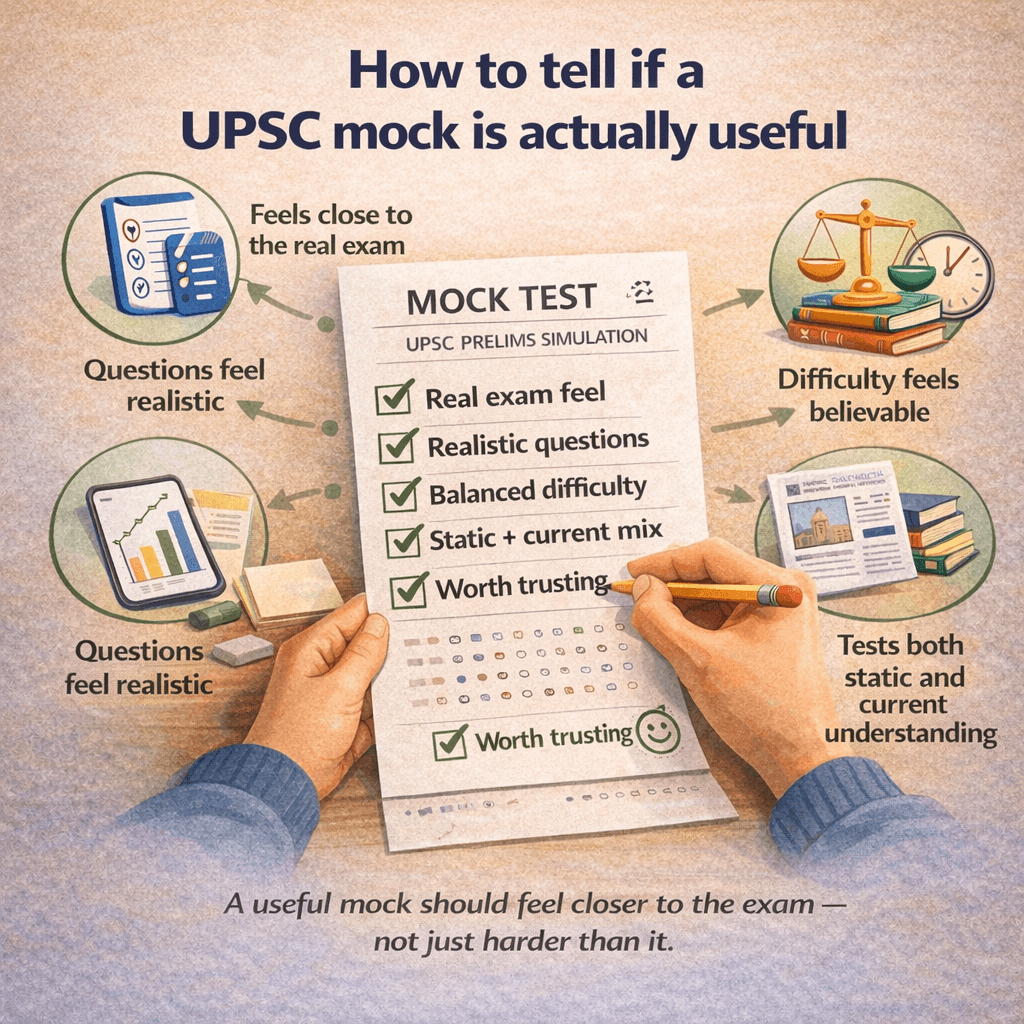
A mock that is genuinely useful for Prelims prep will:
- Mirror real framing — questions should feel like UPSC, not like a trivia quiz
- Mix difficulty sensibly — not uniformly hard or uniformly easy
- Balance static and current-affairs-linked questions — because the actual paper does too
- Challenge your judgment, not just your memory — elimination and reasoning should matter
If a mock regularly surprises you in ways that feel unfair or artificial, it is training the wrong instincts. The goal is to build comfort with the actual exam's logic — not just accumulate a high mock count.
Why a structured approach works better#
One mock gives a snapshot. Improvement comes from running the sequence consistently:
Test → Categorize errors → Pick one focus area → Revise specifically → Retest
 Comparison of isolated mock use vs better UPSC mock test approach
The gap most aspirants skip is the middle step. They go from "I scored 98" straight to "let me revise everything." That is where time gets wasted.
A simple rule: after every mock, you should be able to complete this sentence: "My one focused action before the next mock is ___." If you cannot fill that blank, the analysis is not done yet.
Final thought#
Mock tests are not just for measuring performance. They are meant to improve it.
At its core, the process is simple:
Test → Analyze → Identify weak areas → Practice specifically → Retest